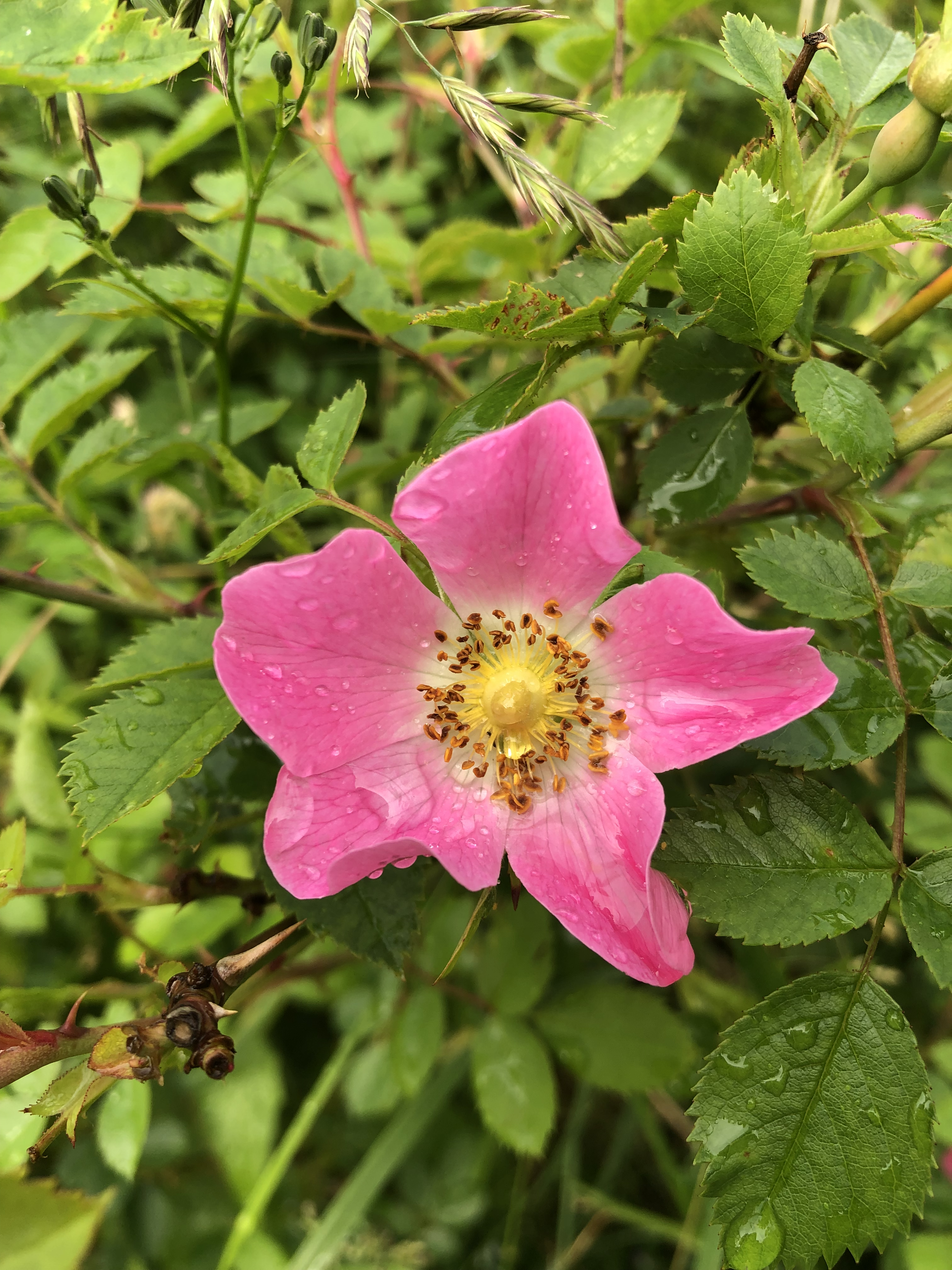
Wild rose on the croft
Next we come to the Scottish wild rose, the dog rose, Rosa canina.
It grows incredibly well here in the Highlands. You would not believe how abundantly it grows once you start noticing it. We also have old bushes growing wild here on the croft. They have been here as long as I can remember and are probably older than me, and I am no spring chicken!
The wild rose is the plant I chose for our branding. Rather than using the traditional Scottish thistle or heather, I was always drawn to the wild rose. It is so feminine. Soft pink and simple.
When the bushes flower in June they are really beautiful.
Harvesting petals and hips
I harvest both the petals and the rose hips from the bushes here on the croft.
As with the other plants I work with, I pick them on a nice sunny day. The best time to harvest the petals is usually mid morning, once the sun has been on them for a while and they are completely dry.
By then the flowers have opened properly and are sitting in the sunshine. That is the perfect time to gather the petals.
Later in the year I also collect the rose hips from the same bushes.
How I use wild rose
Wild rose is a lovely plant to work with and I use it quite extensively in our products.
The petals are infused in oil and then used across several products. You will find them in our soaps, in the body butter and in our Nourish Elixir body oil. I also use them in our solid hand cream.
It is a plant that has long been associated with caring for more mature skin, which is one of the reasons I like working with it.In the soap I combine the rose infusion with pink clay, rose geranium and ylang ylang essential oils. Together they make a gentle blend that works particularly well for more mature skin types, although they are lovely for all skin as well.
I also use the rose infusion in a face mask with pink clay.
So it is definitely one of the plants that appears in quite a few different places across the range.
A traditional plant for skin
The dog rose, Rosa canina, grows widely across the UK and has been used traditionally for generations.
Rose hips are naturally rich in vitamin C and other plant compounds, which is one of the reasons they have been valued for skin care as well as food.
Both the hips and petals contain natural antioxidants such as flavonoids. These are the kinds of plant compounds that help support the skin and protect the plant itself in the wild.
For me though, part of the joy of using it is simply that it grows here, right on the croft.
Here you can find some of the lovely products I make using the wild rose